
There's a special kind of frustration in winter contracting: doing the work perfectly and still not getting paid for it without a fight. The lot was cleared at 4 AM. The customer arrived at 8 AM to a light dusting from the second band of snow, concluded nobody had come, and disputed the invoice. Multiply that by a long season and a few hundred locations, and invoicing becomes the most expensive part of jobs you already did.
The uncomfortable truth about winter work is that the customer almost never sees you do it. Snow removal is a night product sold to daytime people. That means your invoice is only as strong as your documentation, and your documentation is only as strong as what your crews capture while the work happens.
This guide covers the full chain: what to record on site, how to structure pricing so invoices explain themselves, and how to get from "the season happened" to "the invoices are sent" in hours instead of days.
Table of Contents
- Why winter invoices get disputed
- Proof of service: capture it while it happens
- Pricing models that produce clean invoices
- From drives to invoices without retyping
- The accounting hand-off
- Handling the dispute you'll still get
- Conclusion and next steps
Why Winter Invoices Get Disputed
Most invoice disputes in this industry are not about dishonesty on either side. They're about missing shared facts:
- The invisibility problem. The work happened while the customer slept, and fresh snowfall erases the evidence by morning.
- The volume problem. A serious storm can mean hundreds of visits in one night. Reconstructing them a month later from notes and memory produces errors, and customers find the errors.
- The trigger problem. Contracts based on snow depth or ice conditions invite the question "did that night actually qualify?" If you can't answer with data, you answer with a discount.
- The aggregation problem. A single line reading "Winter service, January" invites scrutiny in a way that an itemised list of dated, documented visits does not.
Every one of these has the same root: information that existed at 4 AM but wasn't captured in a usable form.
Proof of Service: Capture It While It Happens
The standard that ends most arguments before they start is per-visit documentation, created on site by the person doing the work:
- Time-stamped check-in and check-out, so the visit has a beginning and an end, not just a claim.
- Photos of the finished result from the crew's phone, attached to the visit. Thirty seconds per site, and by far the strongest single piece of evidence you can hold.
- Work type and materials: salting, clearing, or both, and how much was spread if you bill materials.
- Deviations: the blocked loading bay, the parked car, the gate that wouldn't open. The note that explains a problem at 4 AM prevents the complaint at 9 AM.
Field note: documentation discipline is a design problem, not a personnel problem. If capturing proof takes more than a minute or lives in a separate app from the job list, cold and tired people will skip it. Put the camera and the check-out button on the job itself, and compliance stops being a battle.
This same trail is what protects you beyond invoicing. When a slip-and-fall claim arrives in March asking what happened on a night in January, "checked in 03:41, salted, photo attached" is the difference between a closed inquiry and an expensive one.
Pricing Models That Produce Clean Invoices
The pricing model you sell determines how explainable your invoices are. The common structures each have a documentation requirement built in:
- Seasonal fixed price. One price for the winter, whatever falls. Predictable for both sides, and the invoice is trivial. The documentation still matters, because the customer paying in a snowless December needs to see what they're paying for across the season.
- Per-visit pricing. Fair and transparent, but the invoice is now a list of visits, so every visit needs its evidence. This is where per-visit documentation pays for itself directly.
- Per-hour or per-material pricing. Common for call-outs and heavy events. Requires time records and material logs that match reality, because these invoices get checked the hardest.
- Hybrid contracts. A seasonal base covering standard triggers plus per-visit billing for extraordinary events. Flexible, popular, and only manageable when the system knows which visits fall under the base and which are billable extras.
Whichever mix you sell, the rule is the same: the contract terms need to live on the location in your system, so the billing status of a visit is decided by data, not remembered by whoever writes the invoices.
From Drives to Invoices Without Retyping
The end-of-season (or end-of-month) crunch in most snow companies is a manual translation exercise: from a pile of driver reports into a spreadsheet, from the spreadsheet into the invoicing system, with a human retyping at every step. Slow, and every retype is a chance to bill wrong in either direction.
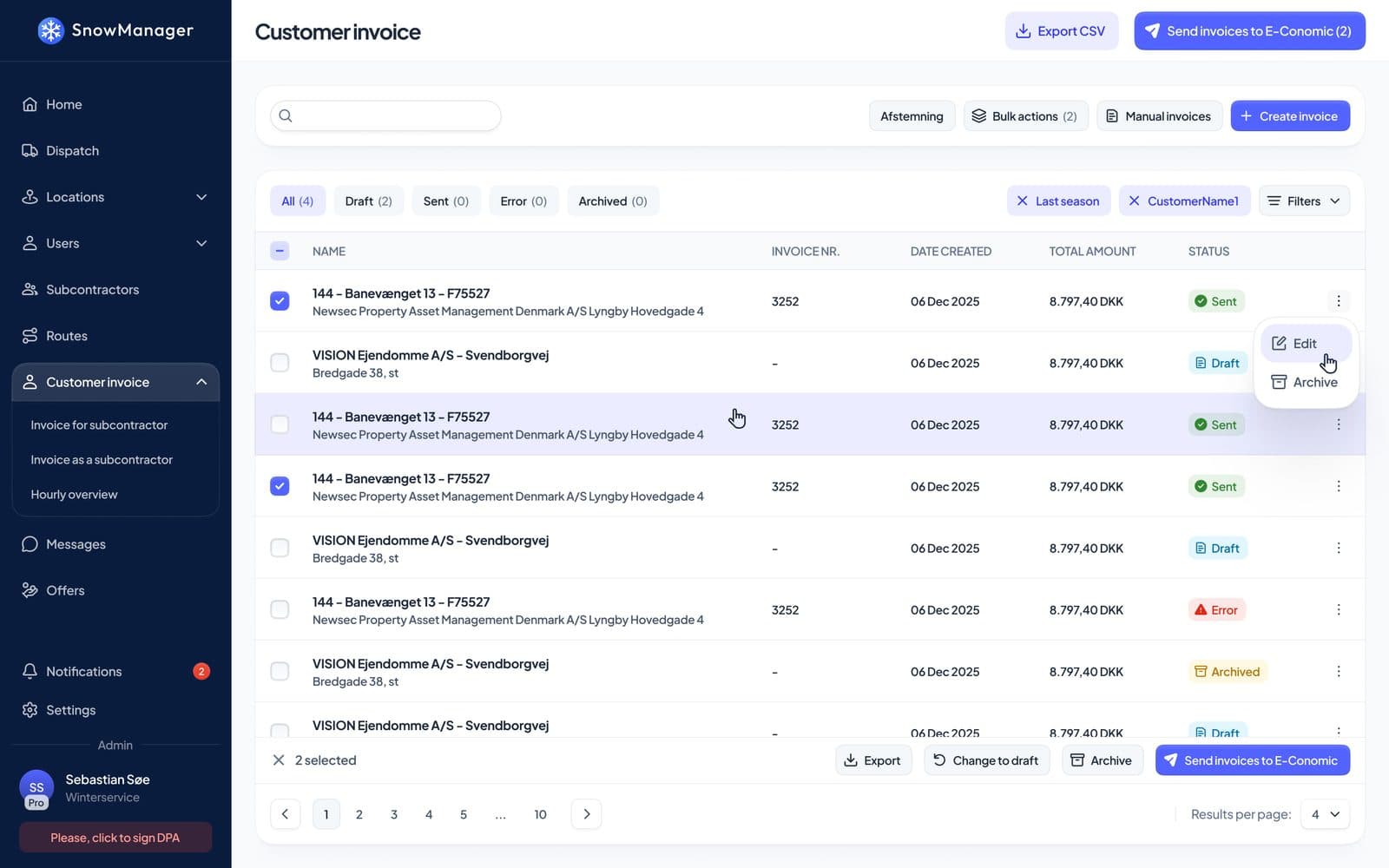
The fix is generating invoices from the operational records themselves. When every drive is already logged against a location with its contract terms, invoicing becomes a review step instead of a data entry step:
- Select the period, and every documented, billable visit is already on the right customer's draft invoice.
- Extras and call-outs carry their documentation with them, so nothing billable disappears and nothing undocumented sneaks on.
- The draft is reviewed by a human, corrected where reality demands it, and sent.
What used to consume days of admin becomes an afternoon, and the invoices that go out are the itemised, evidence-backed kind that get paid instead of queried.
The Accounting Hand-Off
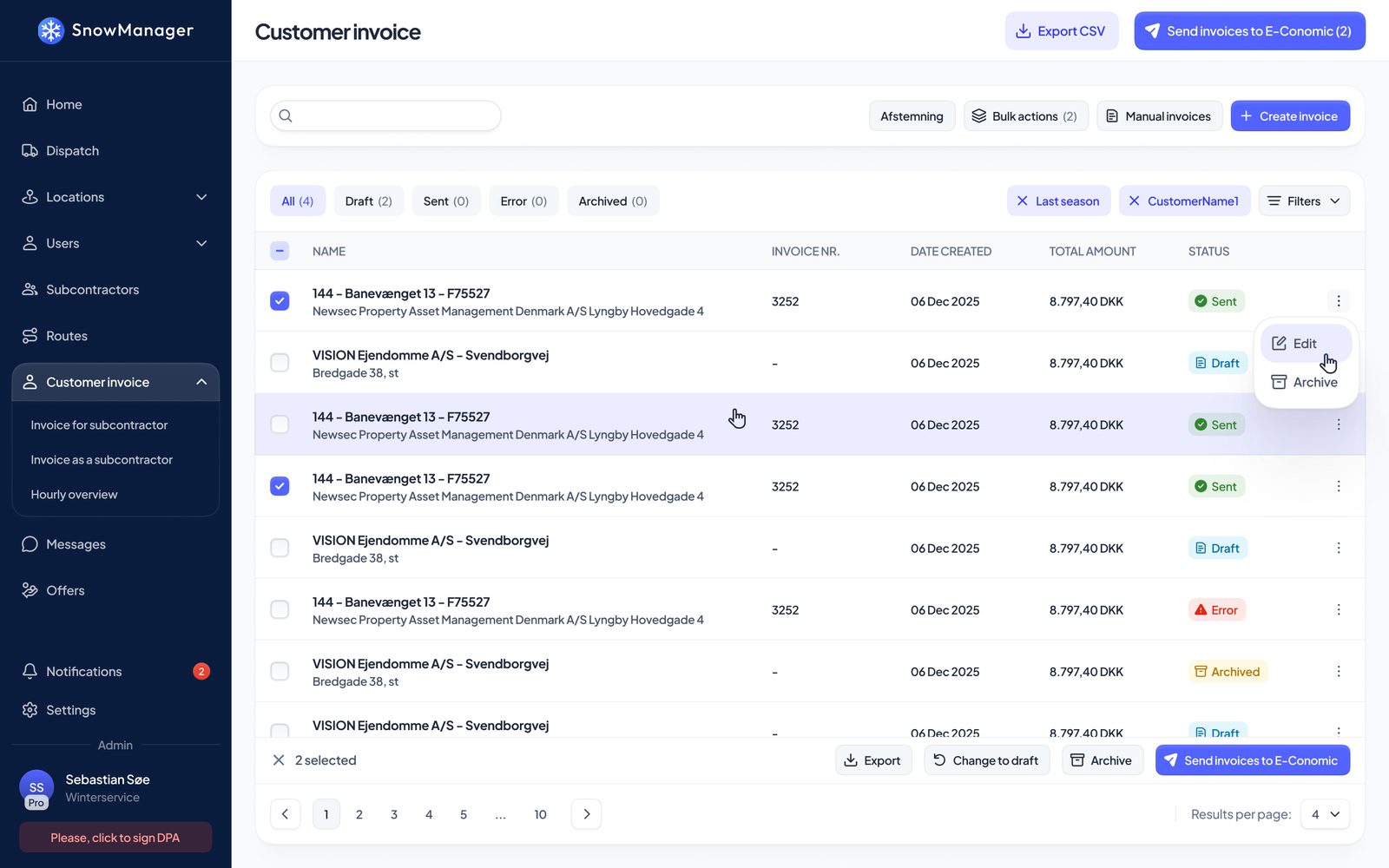
An invoice isn't finished when it's sent, it has to land in your accounting system without being typed a third time. Look for direct integration with your accounting platform (SnowManager sends invoices straight to e-conomic, with CSV export for everything else), so the operational system and the books agree by construction.
The same principle applies on the cost side: when subcontractor settlements are generated from the same drive records as the customer invoices, your margin per contract is a report, not a guess. We covered that side of the workflow in our guide to managing snow removal subcontractors.
Handling the Dispute You'll Still Get
However good the system, someone will still dispute an invoice. What changes is how those conversations go:
- Pull the visit. Date, times, crew, work type, photos, in seconds while the customer is still on the phone.
- Share it, don't argue it. Sending the documented visit to the customer usually ends the discussion. It's hard to dispute a timestamped photograph of their own clean car park.
- When something did go wrong, concede it precisely. Credit the specific visit, not a vague percentage. Customers who watch you self-correct from your own records trust the rest of the season's invoices more, not less.
A dispute handled this way often strengthens the relationship. The customer learns that your invoices mean something, which is exactly the reputation a winter contractor wants going into renewal season.
Conclusion and Next Steps
Getting paid for winter work isn't a collections problem, it's an information problem that gets solved in the field, one documented visit at a time. Capture proof while the work happens, price on contract terms the system knows about, generate invoices from the operational records, and hand them to accounting without retyping.
If your invoicing month still involves spreadsheets and memory, book a demo and we'll show you the path from a night of drives to sent invoices. And if you're planning improvements for next season, start with our snow removal route planning guide: tighter routes make for cleaner records, and cleaner records make for invoices nobody argues with.